
Aussie firms return to Hong Kong as IPO market booms
Hong Kong | Australian companies are flocking back to Hong Kong, attracted by rivers of capital in one of the world’s few expanding stock markets after years of concern over its handling of the pandemic and national security laws.
The number of companies represented in Australian Chamber of Commerce membership has jumped from 240 early last year to 280 now, with almost 1000 individual members from Australian companies like Macquarie, ANZ, QBE, Leighton, Telstra, and local players like Cheung Kong Infrastructure, China Light and Power and Chow Tai Fook Enterprises.
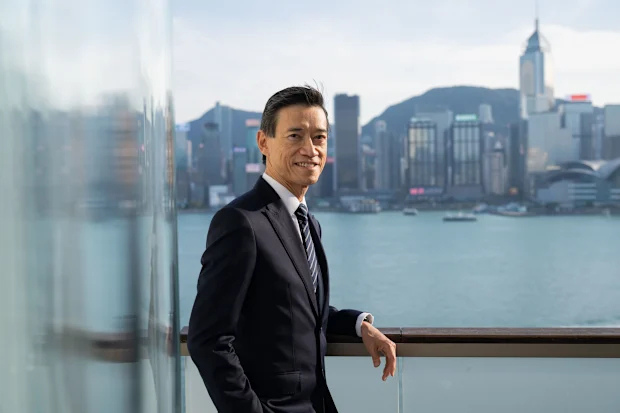
Australian Chamber of Commerce in Hong Kong chair Jason Chang says more Australians are making the move to Hong Kong. Billy Kwok
“We’re seeing definitely Australian businesses coming through here. They’re here for a few reasons – it’s close to capital, the investors and the consumers,” said Jason Chang, who took over as chair of the chamber earlier this month.
“The two largest IPOs in the world this year were mainland [China] companies on a Hong Kong exchange. CATL, they manufacture 40 per cent of electric vehicle batteries in the world. And the second largest is a gold company called Zijing. Their market cap is $US162 billion ($248 billion), they instantly became a top three gold company in the world. So Hong Kong is back on the IPO scorecard.”
It is an apparent reversal from the drift away from the former British colony, which was returned to Chinese rule in 1997 and has been in the headlines for some of the world’s strictest COVID-19 rules and tough national security laws in the years that followed. NAB withdrew from the city in 2023, following Westpac, to focus instead on Shanghai and Singapore.
Still, around 100,000 Australian passport holders call the city home.
“We’re seeing more Australians come back to Hong Kong. The Aussie school has a huge waiting list, and that is a proxy for the population returning to Hong Kong,” Chang said.
“There was a bit of a trough post-COVID, but now it’s come back up to a point where they have a waiting list.”
A spokeswoman for the Australian International School Hong Kong said 57 per cent of students were from Australian families, many of whom moved to work in the finance sector.
By day, Chang is the chief executive and managing director of EMR Capital, a private equity firm specialising in resource investments. A former KPMG partner in charge of Asian markets and Victorian president of the Australia China Business Council, Chang now oversees $US7 billion in assets.
By night, though, he pitches the benefits of Hong Kong to Australian companies looking to set up shop – and vice versa, Hong Kong and Chinese companies looking to expand into Australia. He recently returned from a tour of Canberra and Sydney, where he met political and business leaders.
“The world’s public markets, including the ASX, are shrinking – except for Hong Kong and the New York Stock Exchange,” Chang said.
“It’s very expensive, and quite often you can’t get access. They’re not deep enough markets. So when you list on an exchange, you want to be very liquid. I think you’ll see Hong Kong flourishing.”
Accounting firm Grant Samuel set up a Hong Kong office mid-last year, while investment bank Barrenjoey opened one earlier this year after acquiring New Zealand firm Forsyth Barr.
“Hong Kong is not a population of 7.5 million people. It’s part of the Greater Bay Area, which is about 87 million people. It’s three times Australia,” Chang says, referring to the Guangdong-Hong Kong-Macao region.
“We’ve got about 100 flights a week to six or seven cities in the US, the world’s most important capital market. It’s on the doorstep of the world’s second-largest economy, and the economy that consumes more than half of the world’s key commodities. I think a lot of people see Hong Kong as a gateway to China. It is, but not just to China. Very much to the planet.”
Australia can benefit from the escalating tensions between the US and China, Chang said. Australia has also gained ground in its own relationship with China.
“China will probably look to enhance that relationship with Australia in some shape or form,” he said.