
Foreign chambers back Hong Kong 5-year plan, urge progress on Northern Metropolis
Representatives of foreign business chambers who met Hong Kong’s leader have said the five-year plan provided clear policy priorities for companies’ strategic planning, but called for more concrete timelines and visible progress on the Northern Metropolis project to attract investment.
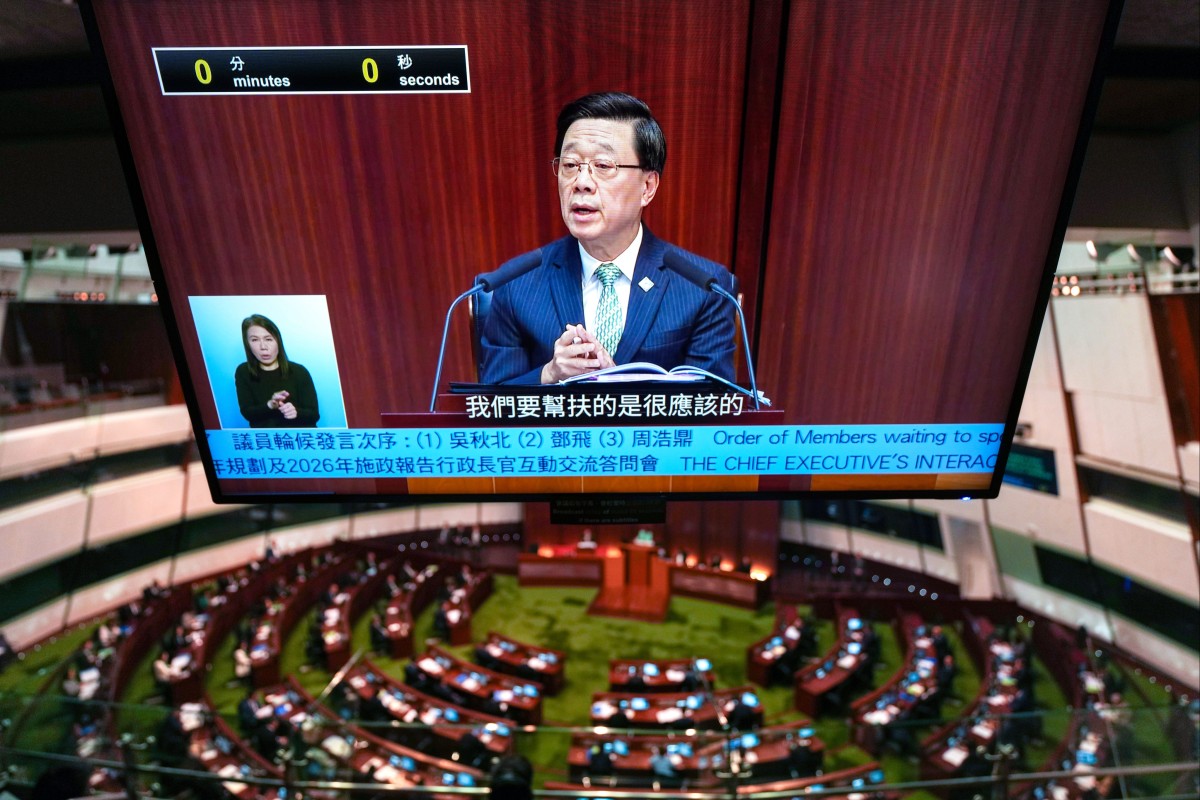
Chief Executive John Lee Ka-chiu held a briefing on Monday for consuls general and heads of foreign chambers of commerce, during which he stressed that Hong Kong’s five-year plan was not a planned economy. The session included representatives from the United States, United Kingdom, Australia and the European Union.
“[The five-year blueprint] is a planning process which combines government policy with market forces, allowing everybody to find the best way to achieve the target with the best results and allowing flexibility in the process, making adjustments when circumstances are beyond your control,” he said.
After the briefing on Hong Kong’s first five-year plan and the policy address unveiled last Wednesday, some chamber leaders said the road map provided policy certainty. They added that the blueprint allowed firms to align their own long-term strategic planning, which was often measured in three- to five-year intervals.
“It tells us exactly where and when the resources will be deployed, and that gives business the confidence to move forward and to be able to invest here,” Mary Simpson, chief executive of the Australian Chamber of Commerce in Hong Kong, said after the briefing.
She said the plan channelled the city’s established pillars – which her chamber viewed as finance, law and logistics – into new growth areas, including artificial intelligence, green technology and critical minerals.
Johannes Hack, chairman of the European Chamber of Commerce in Hong Kong, described the plan as a practical road map for communicating the city’s developmental direction to overseas investors.
Hack and Simpson, who both returned from their chambers’ “door-knock” missions to their home region in recent weeks, said the focus on Hong Kong’s role in helping mainland Chinese businesses go global was attractive to investors in Europe and Australia.
Hack said his chamber’s visit to Brussels and Strasbourg was intended to bridge the gap between his organisation’s on-the-ground experience in the city and what he called a “stuck” perception of Hong Kong that predated its post-pandemic economic recovery.
He said he saw a role for European businesses to advise small and medium-sized Chinese firms in overseas investments on the continent via Hong Kong.
“I think this was a journey more towards re-establishing the overall importance of Hong Kong, and the easiest way we found of doing that was to talk about finance, where it’s very clear that there is a very strong franchise and there is very strong trust,” he said.

Under the five-year plan mapping out the city’s development direction between 2026 and 2030 with both binding and anticipatory targets, fast-tracking the Northern Metropolis has been designated a top priority. The 30,000-hectare megaproject is designed to house technology parks, university campuses and up to 186,000 homes.
Other goals included enhancing the city’s status as an international hub for a variety of industries from finance to innovation, and deepening Greater Bay Area connections.
However, foreign business leaders stressed that attracting overseas capital would require clear execution markers, including “visible” assurance of development timelines.
Simpson of the Australian chamber said her country’s medical technology, infrastructure and logistics firms were keen to raise capital in Hong Kong. She added that firms in her country could lend expertise in public-private partnerships, urban planning, education and healthcare development.
“I think for overseas enterprises to commit to capital, they need to have visibility on the ground,” she said.
“They want to know that their infrastructure follows certain timelines, that where the precincts are focused, how there is cross-boundary collaboration, where that will all actually work in practice.”
Hack highlighted the need for a compelling narrative for business chambers to sell the megaproject to firms back home, noting that few European companies had heard of the project so far.
“The KPIs aren’t really something you can sell to an investor easily, you need storytelling around that,” Hack said.
The chairman said examples of the megaproject’s achievements, such as a novel drug developed there with participation from the Greater Bay Area, would help convince European investors.
Paul McComb, executive director of the British Chamber of Commerce in Hong Kong, said the city government’s “whatever it takes” mindset to remove hurdles around the Northern Metropolis project was an encouraging sight, and that the project’s benefits would begin to show as businesses moved into the proposed tech parks.
“I think they’ve got the right frame of mind to make the Northern Metropolis a huge success,” McComb said.